
Why Working with a Career Coach Changed Everything (And Why You Might Need One Too)
Blake had done everything right.
He had years of real leadership experience, a strong work ethic, and a track record that any employer should have been excited about. Yet, for months, he sent out applications and heard nothing back. In one case, he had been applying to his dream institution for years without a single serious look.
He wasn't lazy or unqualified. He was stuck in the same loop a lot of high-performing professionals find themselves in, doing everything they know how to do and still not getting the result they deserve.
The question underneath all of it was one I hear all the time:
“I know I bring value. Why can’t I get anyone to see it?”
If that question sounds familiar, keep reading.
1. You stop guessing and start knowing exactly where you’re headed.
When Blake first came to me, his plan was straightforward: “I’ll take anything better than this.”
That’s not a career strategy. That’s survival mode.
And it’s more common than people want to admit. When you’ve been spinning your wheels long enough, the goal stops being “find the right fit” and starts being “just get out.” But making a move from that headspace rarely leads anywhere better. It just leads to somewhere different.
One of the most powerful things a career coach does is slow you down long enough to get clear before you move fast. That means figuring out what you want, what you’re genuinely good at, and what kind of work fits who you’re becoming, not just who you’ve been.
Blake came in unclear on direction. He left with a defined professional identity, a targeted job search strategy, and the language to back it up. That shift didn’t happen because he worked harder. It happened because he finally had the right guidance to work smarter.

2. You learn how to say what you do in a way that actually lands.
Here’s something most professionals don’t realize: the problem isn’t always your experience. It’s how you’re communicating it.
Blake had years of leadership in logistics, operations, and high-pressure environments. But on paper, it looked like a list of tasks. He was using phrases like “helped with” and “responsible for” to describe work that was genuinely impressive. No wonder the doors weren’t opening.
Part of what we worked on together was translating his real experience into real impact language. Not “managed routes,” but:
“Redesigned daily operations in response to staffing gaps, keeping service reliable while protecting burnout and safety.”
Not “helped drivers with tablets,” but:
“Coached veteran drivers through digital transitions using step-by-step support, protecting safety, compliance, and trust on the team.”
Those aren’t the same statements. One reads like a job description. The other reads like a leader.
A career coach helps you see the difference and close the gap. Because if the people reading your resume or sitting across from you in an interview can’t see your value, it doesn’t matter how much value you actually have.
3. You stop making career moves out of exhaustion and start making them with clarity.
This one matters more than people give it credit for.
Many professionals don’t leave their jobs because the role is wrong. They leave because they’re tired. And those are two very different problems with two very different solutions.
There are really three things that can make you feel “off” in your career. Burnout, which is an energy and recovery problem. Boredom, which usually means your growth has outpaced your role. And misalignment, which is when your work no longer reflects who you’re becoming. All three feel similar from the inside. But they require completely different responses.
Burnout needs rest, not a new job.
Boredom needs a stretch challenge, not necessarily an exit.
Misalignment needs a real pivot with real clarity, not just a lateral move to somewhere that feels less bad.
A career coach helps you figure out which one you’re actually dealing with before you do something you’ll regret. Because the most expensive career mistakes don’t happen when people stay too long. They happen when people move too fast without knowing why.
4. You get expert guidance instead of figuring it out alone.
Blake described working together as having “a personal trainer for my career.”
I love that framing because it’s exactly right.
Nobody walks into a gym for the first time, picks up the heaviest weight, and figures out their form by trial and error. Not if they want results. Not if they want to avoid getting hurt. They work with someone who has seen it before, who knows what to look for, and who can help them move with intention instead of just effort.
Career coaching works the same way. You’re not just getting accountability. You’re getting a set of experienced eyes on your situation, someone who can spot what you can’t see from the inside and help you move faster than you ever would alone.
With Blake, that looked like interview prep that actually worked. Rewiring the way he answered “Tell me about yourself” so it flowed from his mission and impact instead of a random job history. Practicing real answers to real questions until they stopped sounding like guesses and started sounding like a grounded leader who knew exactly what he brought to the room.
The institutions that had been ignoring him for years started bringing him in for serious interviews. And eventually, he landed the role at the dream institution he had been working toward for years.
He didn’t just walk away with a new job. He walked away with a repeatable framework for his career.
A clear core message. A set of stories that prove his value. A mission and vision he can build on for years to come.
Before you make your next move, know what you’re actually dealing with.
If any part of this resonated with you, it’s probably because you recognize something in Blake’s story. You’re showing up. You’re putting in the work. But something still feels off and you can’t quite name it.
That feeling has a name. And once you know what it is, you can actually do something about it.
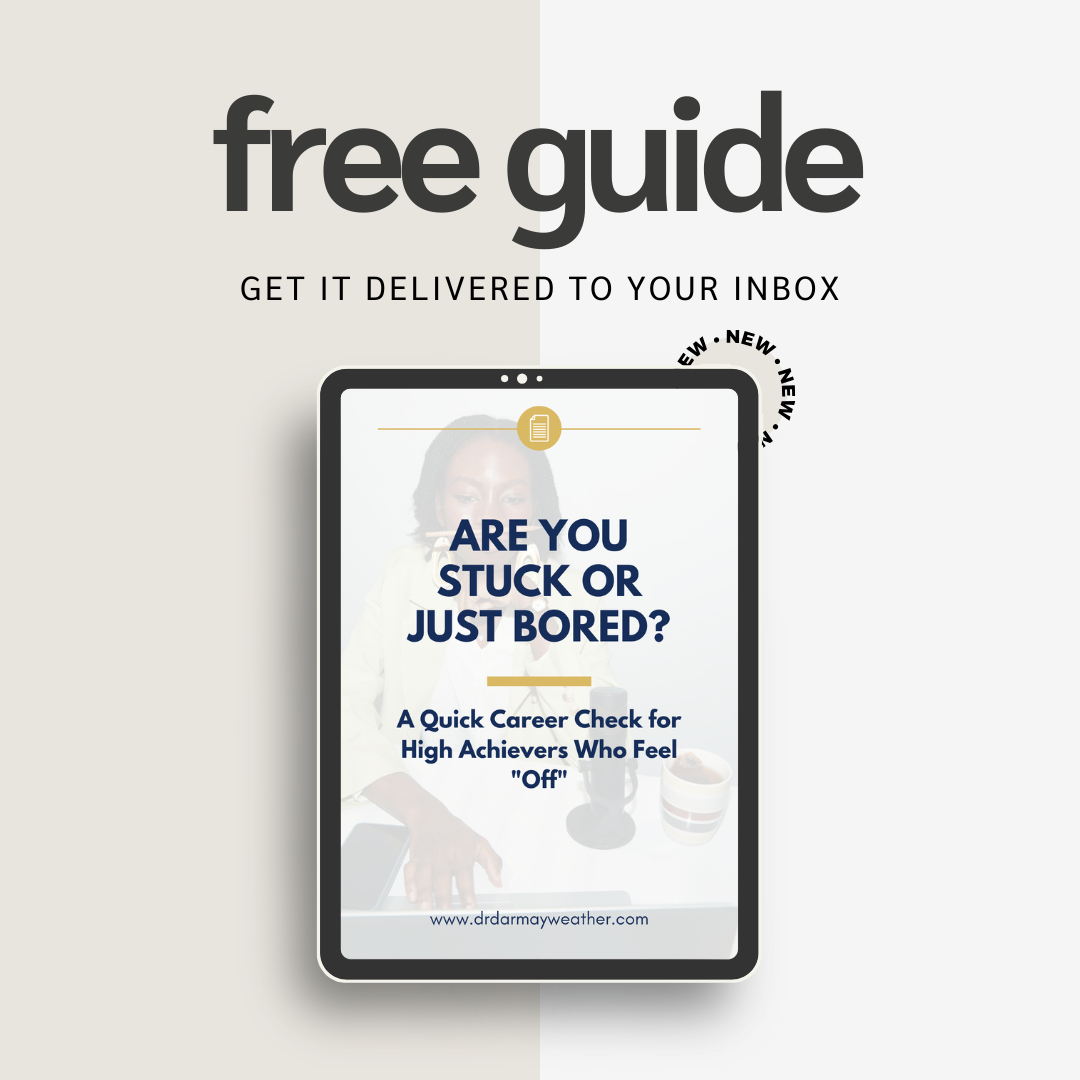
I created a free 5-minute assessment specifically for high achievers who feel “off” but aren’t sure why. It helps you figure out whether you’re dealing with burnout, boredom, or misalignment so your next move is made from clarity, not exhaustion.
➤Take the free “Stuck or Just Bored?” assessment
Not panic. Not a sudden overhaul. Just clarity.
That’s where it starts.
Another blog you might enjoy: How to Clearly Articulate your Value for Career Growth


